When you’re planning a business website , one of the first things you’ll end up juggling is deciding between a static website and a dynamic one. And yeah, it sounds simple at first , but it is more important than it seems because it touches your website’s cost, speed, flexibility , and that long-term scalability you’ll care about later.
In 2026 , companies aren’t only chasing an online presence , they’re trying to build a place that actually supports growth, marketing efforts, and customer engagement. When you understand the difference between static and dynamic websites, you’ll be in a better position to pick the right base or framework for your digital success, sooner rather than later.
What Is a Static Website?
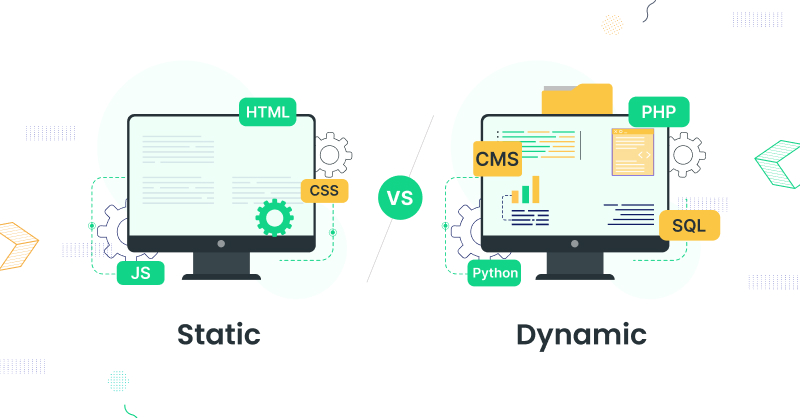
A static website is made up of fixed web pages where content remains the same for every visitor. These pages are built using basic technologies like HTML, CSS, and sometimes JavaScript.
Each page is pre-built and delivered exactly as stored on the server. If any changes are needed, the developer must manually update the code.
Static websites are commonly used for:
- Business landing pages
- Portfolio websites
- Company information websites
- Small informational websites
Because they are simple in structure, static websites are fast, lightweight, and easy to host.
What Is a Dynamic Website?
A dynamic website generates content in real time based on user interaction, database content, or backend logic. These websites are built using technologies like PHP, Python, Node.js, and databases such as MySQL or MongoDB.
Dynamic websites allow users to interact with the platform, such as logging in, submitting forms, making purchases, or viewing personalized content.
Examples include:
- E-commerce websites
- Social media platforms
- Web applications
- Booking systems
- SaaS platforms
Dynamic websites are highly flexible and designed for functionality beyond simple information display.
Key Differences Between Static and Dynamic Websites
The main difference lies in how content is delivered and updated.
Static websites display fixed content, while dynamic websites generate content based on user actions or database inputs.
Static websites are faster and cheaper to build, but they lack flexibility. Dynamic websites are more powerful and scalable but require more development effort and maintenance.
Performance and Speed
Static websites are like really fast, because they just ship pre-built files right to the users. There isnt any need for database stuff , and there is no real server side computation happening.
Dynamic websites tend to feel a bit heavier, since they handle incoming requests, they talk to databases, and they generate content in real time too. Even so, with today’s optimization methods, plus caching tricks that help a lot, these dynamic sites can still land on excellent performance, in practice.
Maintenance and Updates
Static websites require manual updates for every change. This can become time-consuming if the website needs frequent content updates.
Dynamic websites allow content to be updated easily through admin panels or content management systems. This makes them more suitable for businesses that regularly update blogs, products, or services.
Scalability
Static websites are kinda good for small-scale stuff where the content stays mostly the same , for a while. Still, they are not really great for growing businesses, especially if they need frequent updates or more advanced features.
Dynamic websites on the other hand, are very scalable . They can handle thousands of users , huge databases , and pretty complex functionalities , so they end up being a better fit for long-term business expansion.
Security
Static websites are generally more secure because they do not rely on databases or server-side processing, reducing the risk of attacks.
Dynamic websites require stronger security measures because they involve databases, user inputs, and backend logic. However, with proper development practices, they can be made highly secure.
Cost Factor
Static websites are kinda more cost effective and, pretty quick to build. Theyre usually a good fit for startups or small businesses that have limited budgets, and well, not a lot of time to waste.
Dynamic websites, on the other hand, take more time and resources to develop. So they can feel more expensive at first. Still, they tend to bring better lasting benefits for companies that need actual functionality, plus room to grow over time.
Which One Should Your Business Choose?
A static website is the right choice if your business needs:
- A simple online presence
- Limited content updates
- Fast loading speed
- Low development cost
- Informational website or portfolio
A dynamic website is the better option if your business requires:
- User interaction and login systems
- E-commerce functionality
- Regular content updates
- Scalability for future growth
- Advanced features and integrations
Final Verdict
In the “static vs dynamic” website debate there really isn’t one clear universal winner. Honestly it comes down to what you’re trying to achieve for your business, that’s the main point.
If what you need is something simple, quick, and easy on the budget then a static website can be totally enough. But if your focus is more on growth, stronger customer engagement, and long-term scalability, then a dynamic website is the smarter pick, and it usually pays off later.
At YouthTech Solutions LLP, we guide businesses to pick and build the right kind of website that matches their goals , their budget, and also their plans for future expansion. Whether you’re after a lightweight static site, or a more powerful dynamic web application , laying the right groundwork can make a noticeable difference to your online results.

